

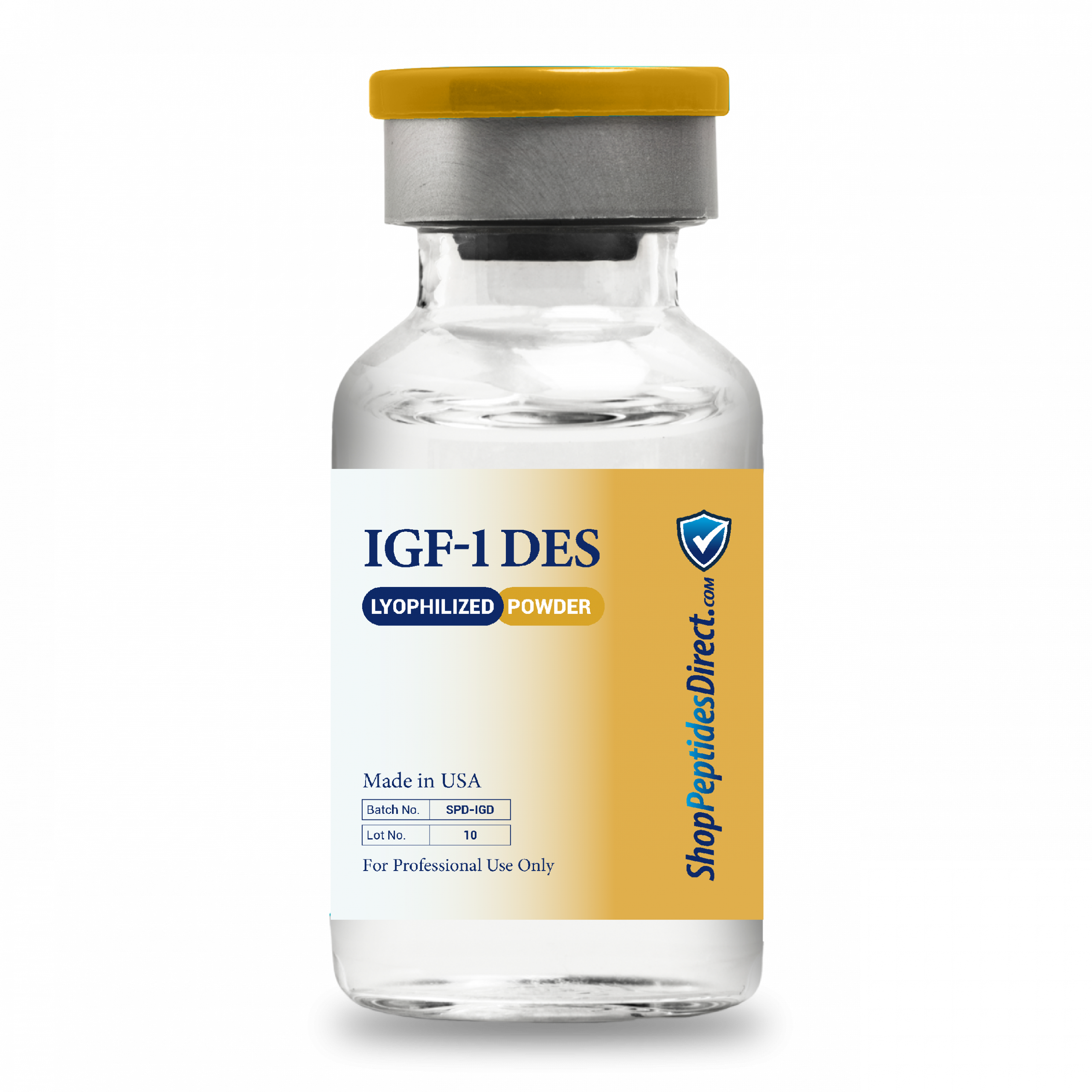
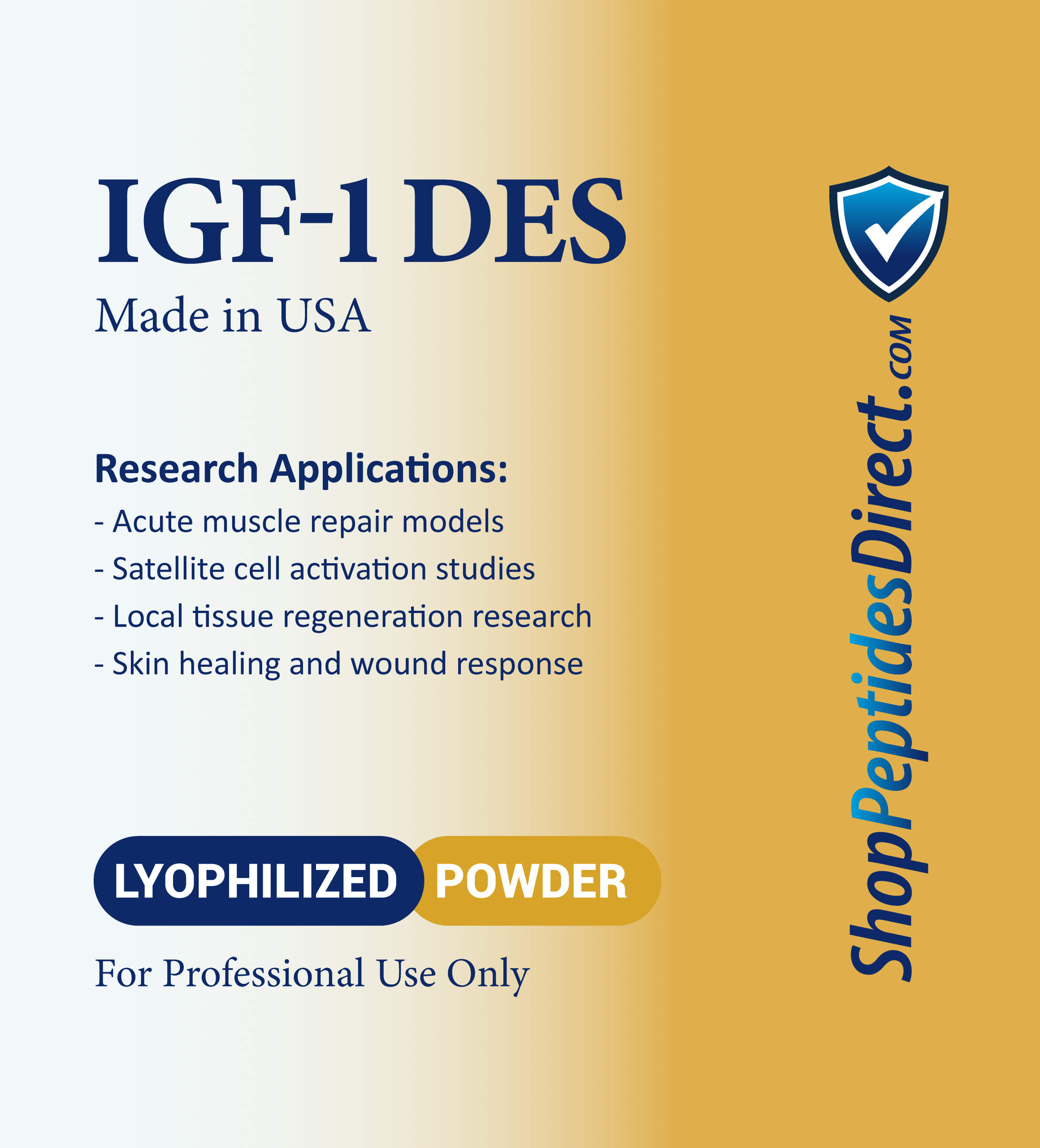

IGF-1 DES
IGF-1 DES (1-3) is a truncated IGF-1 analog with increased potency and faster receptor activation. It is ideal for research into acute cell signaling and localized tissue repair.
$0.00

-
 3rd Party CoA
-
Quality guaranteed
-
Shipped within 24 hours
-
99% Purified
IGF-1 DES (1-3) is a truncated version of Insulin-like Growth Factor-1 designed to have increased potency and receptor affinity. With a shorter amino acid sequence, IGF-1 DES demonstrates a stronger and faster activation of IGF-1 receptors, making it ideal for research focused on acute cell signaling and localized tissue repair.
– Form: Lyophilized peptide
– Purity: >99%
– Origin: Manufactured and tested in the USA
– Certifications: Certificate of Analysis (COA) included
IGF-1 DES works by rapidly binding to IGF-1 receptors, stimulating pathways that drive cell growth, proliferation, and tissue repair. Its enhanced binding affinity is due to the deletion of the first three amino acids from the IGF-1 sequence, which improves receptor activation and reduces interference by IGF-binding proteins.
– Acute muscle repair models
– Satellite cell activation studies
– Local tissue regeneration research
– Skin healing and wound response
– Short-acting anabolic peptide studies
– Rapid and potent receptor activation
– Ideal for short-term, localized research models
– Reduced binding to inhibitory IGF-binding proteins
– Higher bioactivity than standard IGF-1 in certain tissues
Each vial is:
– Produced in a GMP-compliant U.S. facility
– Accompanied by a Certificate of Analysis (COA)
– Verified using HPLC and mass spectrometry
– Shipped with quality control documentation
– Contents: 1mg IGF-1 DES lyophilized powder
– Appearance: White or off-white powder
– Solubility: Reconstitute with sterile bacteriostatic water
– Storage: Store at -20°C; refrigerate after reconstitution and use within 30 days
*For research use only. Not for human or veterinary use.*
IGF-1 DES is shorter and more potent for acute, localized effects, whereas IGF-1 LR3 is designed for long-lasting systemic impact.
Its half-life is short (20–30 minutes), making it well-suited for research on short bursts of cellular activation.
Yes. Every batch is lab-tested and comes with a COA confirming its purity and molecular identity.
Store refrigerated and use within 30 days for best results.
IGF‑1 DES (des(1-3) IGF‑I) · Preclinical Research Overview
Quickstart Highlights
Compound: IGF‑1 DES = des(1‑3) IGF‑I (N‑terminally truncated IGF‑1 analog)
What makes it different: Much lower binding to IGF binding proteins (IGFBPs) → tends to be more “bioavailable”/potent at the receptor level in experimental systems.
Evidence base for dosing: Primarily animal infusion studies and in‑vitro concentration work (no standardized, FDA‑recognized human protocol)
Core research theme: Anabolism / nitrogen retention, growth signaling, tissue‑response modeling
Dosing & Reconstitution
Standard Approach (Preclinical context)
Standard Approach
Important reality: For des(1‑3) IGF‑1, the clearest dosing in the peer‑reviewed record is from animal studies, commonly delivered via continuous infusion (osmotic minipump) rather than intermittent injections.
Examples of in‑vivo research dosing (rats):
- 0.9 mg/kg/day des(1‑3) IGF‑1 via osmotic minipump for 7 days (growth model in nephrectomized rats).
- ~1.08 mg/kg/day des(1‑3) IGF‑1 (reported in diabetic rat anabolic/nitrogen retention work).
- Another related rat protocol reports 1.2 mg/kg/day des(1‑3) IGF‑1 over 7 days.
In‑vitro concentration ranges (example):
- Experimental chamber studies used ~6.7–53 nM ranges when comparing IGF‑1 vs des(1‑3) IGF‑1 effects on insulin release dynamics.
Supplies Needed (Educational / Lab Context)
- Peptide vial (lyophilized)
- Sterile diluent per institutional SOP (sterile water/saline depending on assay)
- Sterile syringes / pipette tips (depending on whether preparing for in‑vivo models or in‑vitro assays)
- Cold storage setup (refrigerator/freezer) + light protection
Protocol Overview
Why protocols look the way they do: Many published in‑vivo protocols use continuous exposure (minipump infusion) to stabilize signaling and avoid peaks/troughs.
Common endpoints studied:
- Body weight change
- Nitrogen retention / protein synthesis
- Tissue‑specific response
- Metabolic readouts (context‑dependent)
Dosing Protocol (Research context)
Research Protocol (In‑Vivo) — Most Citable Structures
- A) Continuous infusion model (7 days): 0.9 mg/kg/day des(1‑3) IGF‑1 × 7 days (osmotic minipump).
- B) Higher infusion dosing used in anabolic/nitrogen retention experiments: ~1.08 mg/kg/day des(1‑3) IGF‑1 (rat model); 1.2 mg/kg/day des(1‑3) IGF‑1 × ~7 days (rat protocol).
Research Protocol (In‑Vitro) — Example Concentration Band: 6.7–53 nM used as a range in comparative experiments (IGF‑1 vs des(1‑3) IGF‑1).
What you should not present as “standardized”: Any “mcg per day” human schedule — because that’s generally derived from non‑clinical, non‑authoritative sources and is not a validated clinical protocol for des(1‑3) IGF‑1.
Storage Instructions
- Keep lyophilized material cold and protected from light
- After reconstitution, follow sterile handling timelines and stability guidance from your lab SOP
- Avoid repeated freeze–thaw cycles (aliquoting is commonly used in lab workflows)
Important Notes
- IGF‑1 DES (des(1‑3) IGF‑1) ≠ IGF‑1 LR3 ≠ recombinant human IGF‑1 (mecasermin). These differ in binding proteins, kinetics, and research use‑cases.
- Des(1‑3) IGF‑1 is often discussed as having reduced IGFBP binding, which can change distribution and clearance behavior.
- Not FDA‑approved as a therapeutic agent; dosing in literature is primarily preclinical.
How This Works
Des(1‑3) IGF‑1 is a truncated IGF‑1 analog designed/observed to:
- Retain affinity for IGF‑1 receptor (IGF‑1R)
- Interact differently with IGF binding proteins (IGFBPs), often described as lower binding, which can increase free fraction in experimental settings.
Benefits & Side Effects (Research Context)
Observed / Investigated Effects
- Increased weight gain and nitrogen retention in certain animal models under specific conditions
- Growth support in models with reduced renal mass (dose‑dependent protocols studied)
Safety Signals / Constraints
- Biodistribution work suggests rapid internalization/catabolism after receptor binding and fast clearance characteristics in certain setups.
- Human safety and dosing standardization: insufficient for protocol‑level claims (for IGF‑1 DES specifically).
Lifestyle Factors
In research discussions, outcomes are highly dependent on:
- Feeding status and protein intake (for nitrogen balance outcomes)
- Training/immobilization conditions (in muscle response models)
- Disease model selection (diabetes, renal mass reduction, injury models)
Administration models used in research
For this educational page, we do not include “how to inject” instructions for IGF‑1 DES, since the strongest literature protocols are animal infusion models (minipumps) and the compound lacks standardized human therapeutic use.
Research delivery methods: osmotic minipump (continuous infusion), local tissue delivery, or cell‑culture exposure — no standardized human injection protocol.
Recommended Source
For IGF‑1 analog research materials, the quality benchmarks you’d highlight are:
- Verified identity/purity analytics (independent COA where possible)
- Sterility/endotoxin controls when relevant to in‑vivo work
- Cold‑chain integrity
Important Note
This content is for educational purposes only and is not medical advice. IGF‑1 DES is for research use only. Not for human consumption. Always consult with qualified professionals before starting any peptide research protocol.
References
-
Rat anabolic/nitrogen retention dosing — including des(1‑3) IGF‑1 ~1.08 mg/kg/day
-
Nephrectomized rat model — des(1‑3) IGF‑1 0.9 mg/kg/day for 7 days
-
Des(1‑3) IGF‑1 additional rat dosing example — 1.2 mg/kg/day
-
In‑vitro concentration range example — 6.7–53 nM
-
Biodistribution/clearance considerations — for labeled des(1‑3) IGF‑1
RELATED PRODUCTS

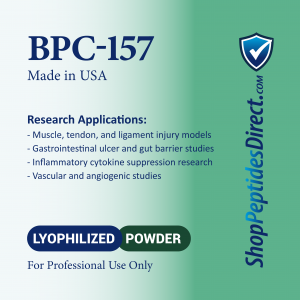
BPC-157
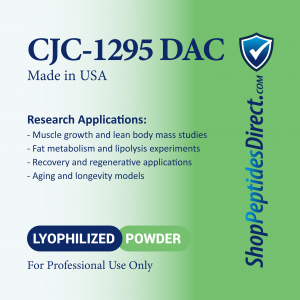
CJC-1295 DAC
Ipamorelin

CJC-1295 + Ipamorelin Blend
Reviews
There are no reviews yet.