

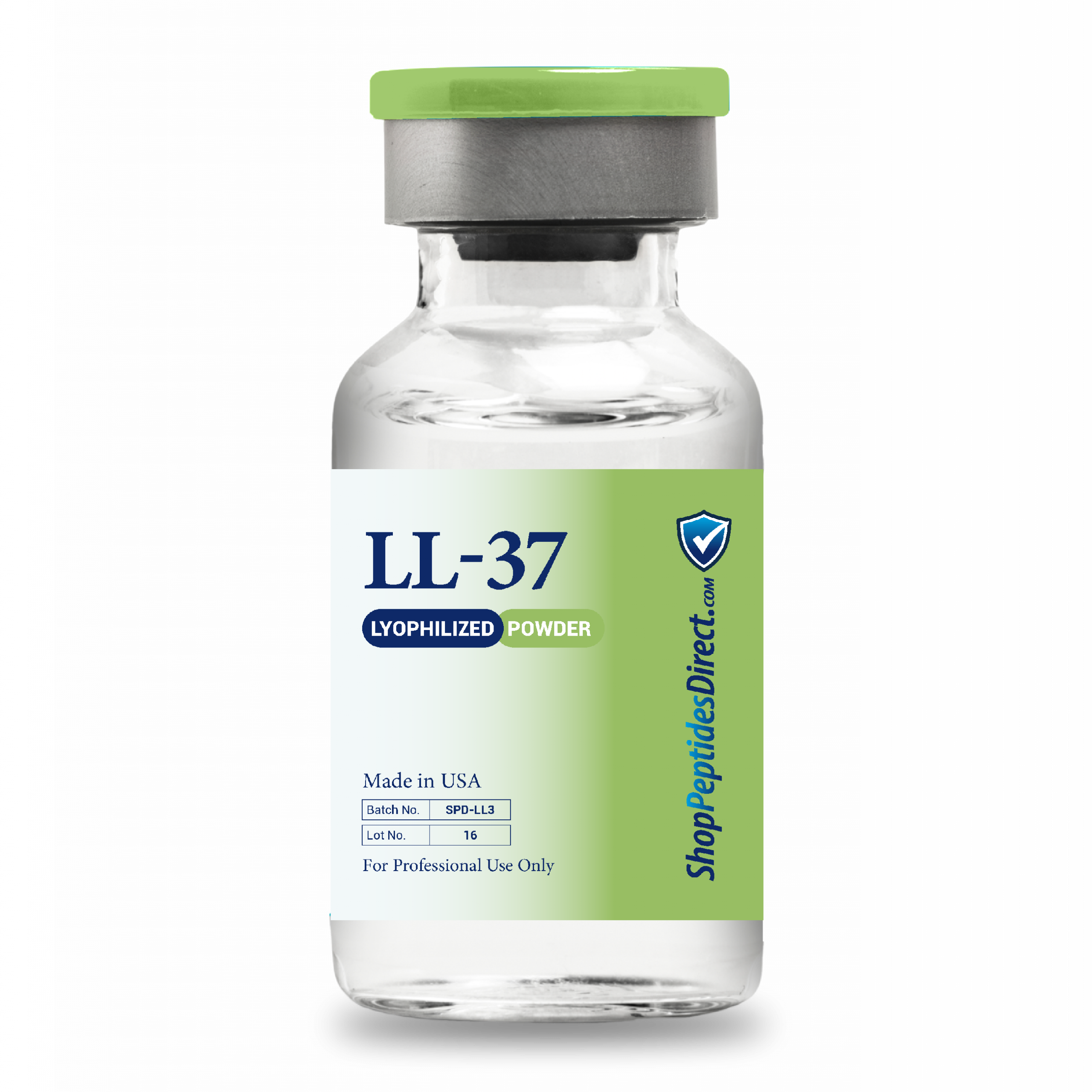
LL-37
LL-37 is a human antimicrobial peptide that provides innate immune defense. It’s studied for its ability to disrupt microbes, modulate immune response, and accelerate tissue repair.
$53.99

-
 3rd Party CoA
-
Quality guaranteed
-
Shipped within 24 hours
-
99% Purified
LL-37 is a human cathelicidin antimicrobial peptide that plays a critical role in the body’s innate immune defense. It is studied for its ability to disrupt microbial membranes, modulate immune responses, and accelerate tissue repair and regeneration. LL-37 is a subject of interest in wound healing, dermatology, and infectious disease models.
– Form: Lyophilized peptide
– Purity: >99%
– Origin: Manufactured and lab-tested in the USA
– Documentation: Certificate of Analysis (COA) included
LL-37 exerts its antimicrobial activity by binding to and disrupting bacterial membranes. It also modulates host cell signaling by influencing cytokine production, angiogenesis, and epithelial repair. This dual function makes LL-37 a powerful peptide for immune defense and wound regeneration research.
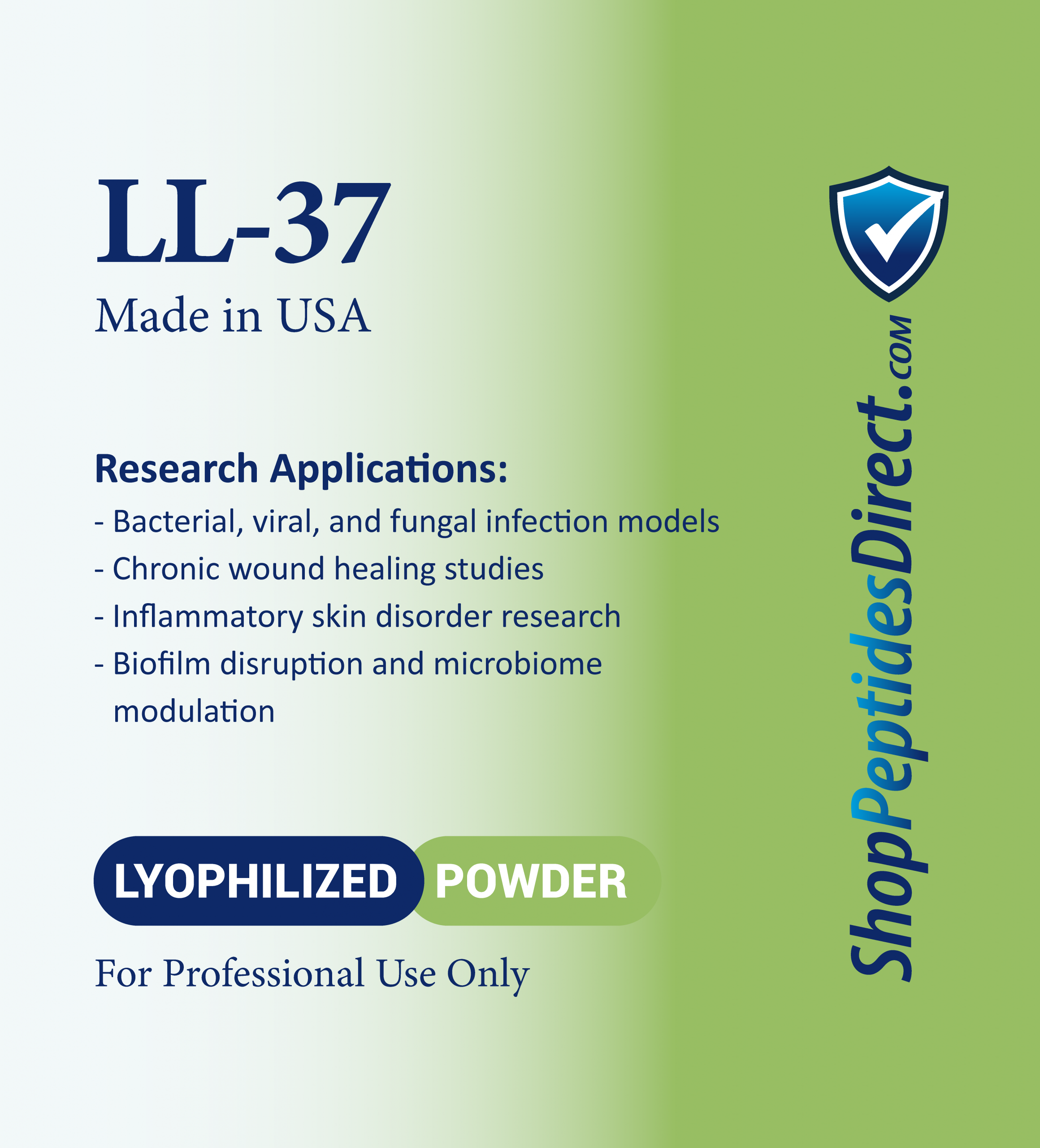
– Bacterial, viral, and fungal infection models
– Chronic wound healing studies
– Inflammatory skin disorder research
– Biofilm disruption and microbiome modulation
– Innate immune system enhancement
– Broad-spectrum antimicrobial action
– Enhances epithelial cell migration and healing
– Modulates inflammation and cytokine response
– Promotes tissue regeneration and angiogenesis
Each vial is:
– Produced in a GMP-compliant U.S. facility
– Accompanied by a Certificate of Analysis (COA)
– Verified via HPLC and mass spectrometry
– Shipped securely with quality-control documentation
– Contents: 10mg LL-37 lyophilized peptide
– Appearance: White to off-white crystalline powder
– Solubility: Reconstitute with sterile bacteriostatic water
– Storage: Store lyophilized at -20°C; refrigerate after reconstitution and use within 30 days
*For research use only. Not for human or veterinary consumption.*
– Intended for laboratory research only
– Not approved for human consumption or clinical use
– Buyer assumes all responsibility for research use and compliance
LL-37 is investigated for its antimicrobial action and wound healing potential, especially in chronic skin conditions and immune response studies.
LL-37 enhances keratinocyte migration, modulates inflammation, and promotes angiogenesis, all key to effective healing.
It has shown broad-spectrum activity against bacteria, fungi, and viruses in in vitro models, making it widely applicable in infection-related studies.
Each batch is tested for >99% purity and verified via HPLC and mass spectrometry, accompanied by a COA.
LL-37 (5 mg Vial) Dosage Protocol
Quickstart Highlights
LL-37 (also known as CAP-18) is a 37-amino-acid cationic antimicrobial peptide derived from the C-terminal of human cathelicidin (hCAP18)[1]. It is the only known human cathelicidin, exhibiting broad-spectrum antibacterial activity and immune-modulating properties[2][3]. This educational protocol presents a once-daily subcutaneous approach using a practical dilution for clear insulin-syringe measurements.
- Reconstitute: Add 3.0 mL bacteriostatic water → ~1.67 mg/mL concentration.
- Typical daily range: 100–400 µg once daily (gradual titration).
- Easy measuring: At 1.67 mg/mL, 1 unit = 0.01 mL ≈ 16.7 µg on a U-100 insulin syringe.
- Storage: Lyophilized: freeze at −20 °C (−4 °F); after reconstitution, refrigerate at 2–8 °C (35.6–46.4 °F) for up to 4 weeks; avoid freeze–thaw cycles.
Dosing & Reconstitution Guide
Educational guide for reconstitution and daily dosing
Standard / Gradual Approach (3 mL = ~1.67 mg/mL)
| Week | Daily Dose (µg) | Units (per injection) (mL) |
|---|---|---|
| Week 1 | 50 µg | 3 units (0.03 mL) |
| Week 2 | 100 µg | 6 units (0.06 mL) |
| Week 3 | 150 µg | 9 units (0.09 mL) |
| Week 4 | 200 µg | 12 units (0.12 mL) |
| Week 5 | 250 µg | 15 units (0.15 mL) |
| Week 6 | 300 µg | 18 units (0.18 mL) |
| Week 7 | 350 µg | 21 units (0.21 mL) |
| Week 8 | 400 µg | 24 units (0.24 mL) |
Frequency: Inject once daily subcutaneously. Some protocols use a 5-days-on, 2-days-off schedule. For ≤10-unit (≤0.10 mL) administrations during early titration, consider 30- or 50-unit insulin syringes for improved readability.
Reconstitution Steps
- Draw 3.0 mL bacteriostatic water with a sterile syringe.
- Inject slowly down the vial wall; avoid foaming.
- Gently swirl/roll until dissolved (do not shake).
- Label and refrigerate at 2–8 °C (35.6–46.4 °F), protected from light.
Supplies Needed
Plan based on an 8–16 week daily protocol with gradual titration.
- Peptide Vials (LL-37, 5 mg each):
- 8 weeks ≈ 3 vials
- 12 weeks ≈ 5 vials
- 16 weeks ≈ 7 vials
- Insulin Syringes (U-100):
- Per week: 7 syringes (1/day)
- 8 weeks: 56 syringes
- 12 weeks: 84 syringes
- 16 weeks: 112 syringes
- Bacteriostatic Water (10 mL bottles): Use ~3.0 mL per vial for reconstitution.
- 8 weeks (3 vials): 9 mL → 1 × 10 mL bottle
- 12 weeks (5 vials): 15 mL → 2 × 10 mL bottles
- 16 weeks (7 vials): 21 mL → 3 × 10 mL bottles
- Alcohol Swabs: One for the vial stopper + one for the injection site each day.
- Per week: 14 swabs (2/day)
- 8 weeks: 112 swabs → recommend 2 × 100-count boxes
- 12 weeks: 168 swabs → recommend 2 × 100-count boxes
- 16 weeks: 224 swabs → recommend 3 × 100-count boxes
Protocol Overview
Concise summary of the once-daily regimen.
- Goal: Support antimicrobial defense and wound-healing processes[4][5].
- Schedule: Daily subcutaneous injections for 8–12 weeks (extend to 16 weeks if desired).
- Dose Range: 50–400 µg daily with gradual titration.
- Reconstitution: 3.0 mL per 5 mg vial (~1.67 mg/mL) for accurate unit measurements.
- Storage: Lyophilized frozen; reconstituted refrigerated; avoid repeated freeze–thaw.
Dosing Protocol
Suggested daily titration approach.
- Start: 50–100 µg daily; increase by ~50 µg each week as tolerated.
- Target: 200–400 µg daily by Weeks 4–8.
- Frequency: Once per day (subcutaneous); optional 5-on/2-off schedule.
- Cycle Length: 8–12 weeks; optional extension to 16 weeks.
- Timing: Any consistent time; rotate injection sites.
Storage Instructions
Proper storage preserves peptide quality[6][7].
- Lyophilized: Store at −20 °C (−4 °F) in dry, dark conditions; stable ~24 months.
- Reconstituted: Refrigerate at 2–8 °C (35.6–46.4 °F) for up to 4 weeks; frozen at −20 °C (−4 °F) for up to 6 months.
- Allow vials to reach room temperature before opening to reduce condensation uptake.
Important Notes
Practical considerations for consistency and safety.
- Use new sterile insulin syringes; dispose in a sharps container[8].
- Rotate injection sites (abdomen, thighs, upper arms) to reduce local irritation[9].
- Inject slowly; wait a few seconds before withdrawing the needle.
- Document daily dose and site rotation to maintain consistency.
- Early-phase doses (≤10 units) benefit from 30- or 50-unit syringes for precision.
How This Works
LL-37 exerts both direct and indirect antimicrobial effects. Its amphipathic, cationic α-helical structure (net +6 charge) allows it to preferentially bind and disrupt negatively charged microbial membranes[2]. Beyond direct killing, LL-37 modulates host immunity: in murine sepsis models, it induced neutrophils to release microvesicles rich in antimicrobial proteins, lowering bacterial burden and improving survival[3]. LL-37 can also bind bacterial lipopolysaccharide (LPS) and block its interaction with CD14/TLR4, reducing endotoxin-triggered TNF release and neutrophil apoptosis[2]. These combined mechanisms help explain its potential in infection control and tissue-repair contexts.
Potential Benefits & Side Effects
Observations from preclinical and clinical literature.
- In chronic venous leg ulcers (which often lack endogenous LL-37), topical treatment with synthetic LL-37 significantly accelerated healing rates compared to placebo[4].
- In diabetic foot ulcer trials, LL-37 cream improved granulation tissue formation and wound closure[5].
- Broad-spectrum antimicrobial action helps clear infections; in experimental sepsis models, LL-37 treatment reduced bacterial loads and mortality[3].
- Generally well tolerated; occasional mild injection-site reactions (redness, itch) may occur with subcutaneous administration.
Lifestyle Factors
Complementary strategies for best outcomes.
- Optimize vitamin D status, as vitamin D upregulates endogenous cathelicidin/LL-37 expression[10].
- Support wound healing with adequate protein intake and micronutrient sufficiency (zinc, vitamin C).
- Maintain proper wound hygiene and dressing protocols if using for tissue-repair goals.
- Prioritize sleep and stress management to support immune function and recovery.
Injection Technique
General subcutaneous guidance from clinical best-practice resources[11].
- Clean the vial stopper and skin with alcohol; allow to dry.
- Pinch a skinfold; insert the needle at 45–90° into subcutaneous tissue[9][12].
- Do not aspirate for subcutaneous injections; inject slowly and steadily[12].
- Rotate sites systematically (abdomen, thighs, upper arms) and move at least 2–3 cm from the previous site[9].
- Use aseptic technique; always use a new sterile needle and syringe for each injection[8].
Recommended Source
We recommend Shop Peptides Direct for high-purity LL-37 (5 mg).
Why Shop Peptides Direct?
- High-purity (≥99%), third-party-tested lots with batch COAs.
- Consistent, ISO-aligned handling and documentation.
- Reliable fulfillment to maintain cold-chain integrity.
Important Note
This content is for educational purposes only and is not medical advice. LL-37 is for research use only. Not for human consumption. Always consult with qualified professionals before starting any peptide research protocol.
References
-
DiVA Portal / Wound Repair and Regeneration — Evaluation of LL-37 in healing of hard-to-heal venous leg ulcers: multicentric RCT
-
Journal of Immunology (PMC) — Little peptide, big effects: the role of LL-37 in inflammation and autoimmune disease
-
Innate Immunity (PMC) — Antimicrobial peptide LL-37 ameliorates a murine sepsis model via microvesicle release from neutrophils
-
Wound Repair and Regeneration (PMC) — Evaluation of LL-37 in healing of hard-to-heal venous leg ulcers: a multicentric prospective RCT
-
Archives of Dermatological Research (PMC) — Efficacy of LL-37 cream in enhancing healing of diabetic foot ulcer: a randomized double-blind controlled trial
-
Bachem Knowledge Center — Handling and storage guidelines for peptides
-
CDC One & Only Campaign — One needle, one syringe, only one time (injection safety)
-
Johns Hopkins Arthritis Center — How to give a subcutaneous injection (site selection, rotation)
-
PubMed / Journal of Steroid Biochemistry — Vitamin D and the antimicrobial peptide cathelicidin (LL-37)
-
MedlinePlus (NIH) — Subcutaneous (SQ) injections: patient instructions
-
CDC — Vaccine Administration: Subcutaneous Injection — Technique, angle, aseptic procedure, no aspiration required
-
NCBI Bookshelf — Injection Best Practices — Asepsis, preparation, and administration techniques
RELATED PRODUCTS
Glutathione
NAD+
Reviews
There are no reviews yet.